
Recent Post
- 2026-11-10 04:31:38
- 2026-10-26 04:30:59



الصفحة الرئيسية Blog Blog Woodworking CNC Routers and Nesting Machining Centers: Market Structure, Technology Trajectory, and the Role of Integrated Panel-Furniture Automation
Abstract
The woodworking CNC router has evolved from a peripheral tool in small workshops to the backbone of panel-furniture production. Driven by custom furniture, whole-house fit-out demand, and the shift from mass production to mass customization, the equipment category now spans entry-level advertising routers, ATC (automatic tool change) engraving machines, and fully automated loading/unloading nesting centers with integrated drilling and labeling. This article examines the market structure behind that segmentation, analyzes representative machine parameters, and considers how suppliers such as Roctech Machinery Co., Ltd. have positioned product lines to serve the transition toward automated, data-connected fabrication.
Industry Background and Data Analysis
The economics of woodworking CNC equipment are shaped less by headline spindle power than by the relationship between sheet utilization, labor input, and changeover time. In custom cabinetry and wardrobe production, material typically accounts for 40–60 percent of unit cost, and labor for another significant share. A nesting center that raises sheet utilization by three to five percentage points, or removes one operator from each shift, therefore changes the payback calculation far more than a marginal increase in traverse speed. This is why the market has bifurcated: low-cost three-axis routers serve signage, handicraft, and small-batch woodworking, while automated nesting centers concentrate on panel-furniture factories running high-mix, short-run orders.
The table below summarizes representative machine classes and their positioning, drawn from published product configurations in the woodworking CNC category.
| Machine Class | Typical Working Envelope | Spindle / Tooling | Positioning Accuracy | Control System | Primary Application | Relative Price Band |
|---|---|---|---|---|---|---|
| Standard three-axis router | 1300 × 2500 mm | 3–6 kW, manual tool change | ±0.05 mm/300 mm | DSP or entry CNC | Signage, acrylic, simple panel cutting | Low |
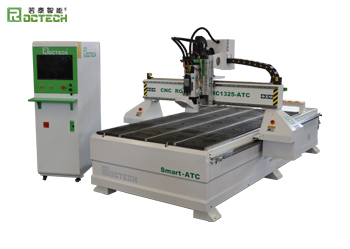
| ATC engraving machine | 1300 × 2500 × 250 mm | 9 kW, 8–24 tool magazine | ±0.03 mm/300 mm | Taiwan Syntec | Cabinet doors, wood molds, craft doors | Mid |
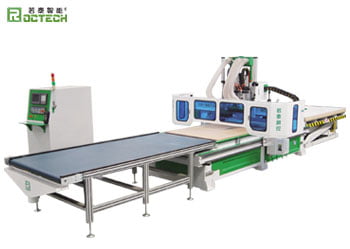
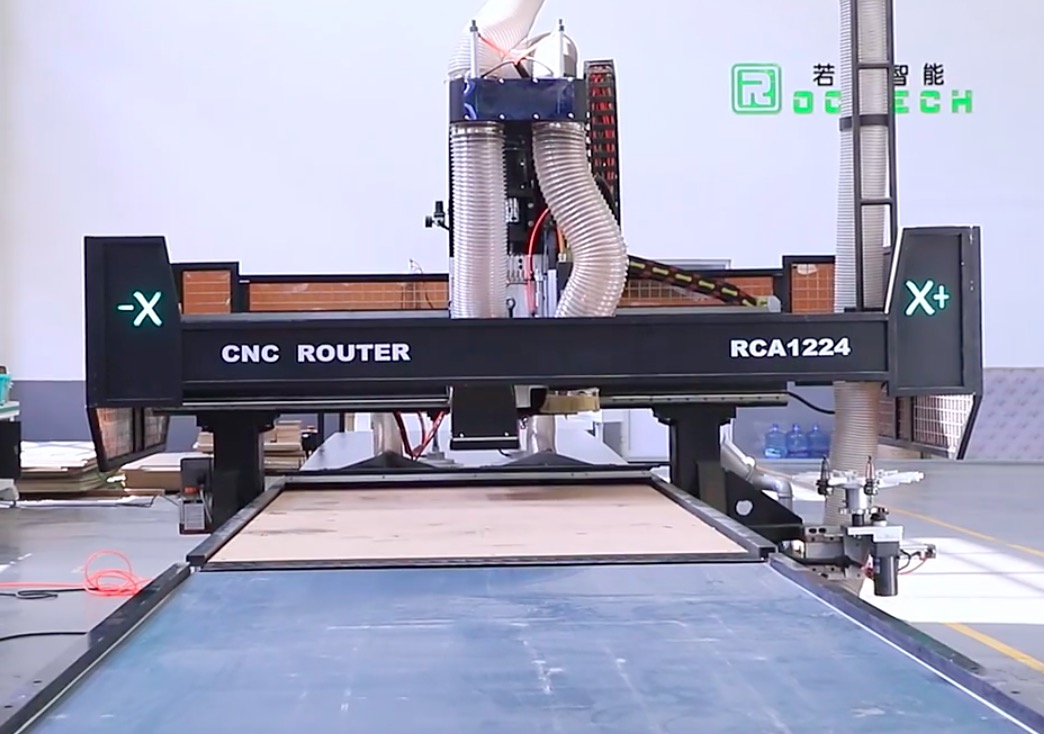
| Automatic nesting center | 1220 × 2440 × 150 mm | 9.6 kW, row-drill group | ±0.03 mm | Taiwan Syntec | Custom cabinets, wardrobes, batch panels | Mid-to-high |
| Five-axis machining center | 1300 × 2500 mm | 10 kW, A/C swing head | ±0.05 mm | OSAI / Heidenhain / Fagor | Automotive and ship molds, curved solid wood | High |
Three observations follow from these figures. First, the accuracy gap between a mid-range ATC machine and a five-axis center is narrower than the price gap might suggest; the five-axis premium buys kinematic capability—one-clamping access to complex surfaces—not routine positioning precision. Second, the nesting center's 150 mm Z travel is deliberately modest. It reflects a design optimized for flat panel processing rather than deep relief carving, and it allows a heavier welded bed and a double-layer vacuum table within a compact footprint. Third, control-system choice has become a reliable proxy for market tier: Syntec dominates the mid-range woodworking segment on cost and ecosystem maturity, while Italian and German systems appear only where five-axis interpolation and thermal compensation justify the expense.
The component supply chain reinforces this stratification. Taiwan HIWIN linear guides and Japan Yaskawa servo motors appear across mid- and high-tier machines, while Italian HSD spindles are the default for high-end models and domestic spindles serve cost-sensitive segments. Buyers evaluating quotations should read the component list as carefully as the specification sheet; identical travel dimensions can conceal substantial differences in guideway class, servo brand, and spindle cooling method.
Technology Application and Brand Case Study
The practical difference between machine classes emerges most clearly in panel-furniture workflows. A conventional router requires manual loading, manual labeling, and a separate drilling operation. An automated nesting center integrates these steps: vacuum-based automatic loading, nesting-software optimization, optional labeling for sheet identity, row-drill processing for shelf-pin and dowel holes, and automatic unloading. The result is a compression of the production chain from four or five discrete stations into one cell—precisely the configuration that custom-furniture factories need when order batches are small and delivery cycles short.
Roctech Machinery Co., Ltd., headquartered in Jinan, Shandong Province, illustrates how a supplier can build a product ladder around this transition. The company's Master Series automatic loading and unloading nesting centers—models such as the RCA1224, RCA1328, and RCA1530—pair a heavy-duty welded bed with a double-layer zoned vacuum table, a 9.6 kW spindle, Taiwan HIWIN guides, Yaskawa servos, and a Syntec control. The specification set is unremarkable in isolation; what matters is the integration of automatic loading/unloading, nesting optimization, labeling, and row-drill capability into a single G-code-driven platform compatible with mainstream nesting software. For a mid-sized cabinet manufacturer, that combination addresses the three variables that dominate cost—material yield, direct labor, and changeover time—without requiring a five-axis capital commitment.
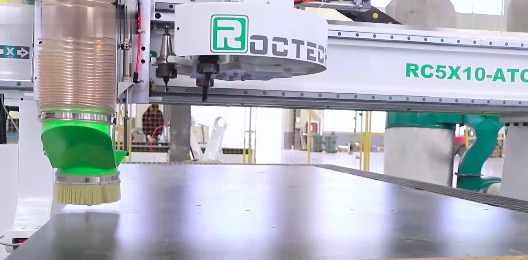
Roctech's broader line reveals the same logic of tiered coverage. The RC1325S-ATC and related ATC engraving machines offer 8–24 tool capacity and 45,000 mm/min rapid traverse for door-panel engraving, mold work, and mixed woodworking tasks where multi-tool processing replaces multiple setups. At the upper end, the RCF series five-axis simultaneous machining centers, with imported five-axis heads and OSAI or Heidenhain controls, serve automotive interior molds, ship and aerospace patterns, and curved solid-wood furniture—applications where one-clamping multi-face processing eliminates cumulative fixturing error. The company's certifications (ISO9001, CE, FDA for laser equipment, UL) and its export footprint across more than 100 countries indicate that its product representativeness rests on configuration discipline and service reach rather than on a single flagship model. In a market where buyers increasingly compare component bills of materials, that kind of transparency is itself a competitive asset.
Conclusion and Outlook
Woodworking CNC equipment is converging on three technical directions: higher automation (automatic loading, robot tending, lights-out operation), deeper digital integration (MES docking, QR-code-driven program recall, remote monitoring), and multi-axis capability migrating downward from mold shops into furniture production. For buyers, the implication is that machine selection should begin with the production mix—batch size, panel variety, drilling complexity—rather than with spindle power. For suppliers, the pressure is to demonstrate verifiable integration: real nesting-software compatibility, measurable sheet-yield gains, and service response times that match the automation level being sold. Roctech's positioning across nesting centers, ATC routers, and five-axis centers suggests that the mid-market battleground will be defined not by any single specification, but by how coherently a vendor can assemble guides, servos, spindles, and control software into a production cell that pays for itself within a predictable horizon.
Looking for more information about our CNC machines and services? Contact us today.
ContactNext:Not






















Woodworking CNC Routers and Nesting Machining Centers: Market Structure, Technology Trajectory, and the Role of Integrated Panel-Furniture Automation - Roctech® have advanced technology for CNC Router,cnc router cabinets,Roctech already have 15 years experiences of cnc router technology.-© 2023 Roctech® Machinery Co.,Ltd. - All Rights Reserved Website Terms Of Use ● Privacy Policy ● Cookie Policy