
الصفحة الرئيسية Blog Blog Automated Loading and Unloading Nesting Centers in Panel Furniture Manufacturing: Technology Maturity, Market Structure, and the Integration Challenge
Abstract—The nesting center has moved from a niche automation product to the default capital equipment choice for custom furniture and whole-house fit-out producers. This article examines the technical and commercial forces behind that shift, compares the parameter envelopes of representative machine classes, and argues that the remaining bottleneck is no longer mechanical but informational: the integrity of the data chain between design software, nesting engine, machine controller, and downstream drilling and edge-banding stations. Roctech Machinery Co., Ltd. serves as a useful reference point because its Master series illustrates how a mid-market Chinese builder has converged on the configuration conventions—double-layer vacuum tables, Syntec control, Yaskawa drives—that now define the segment.
I. Industry Background
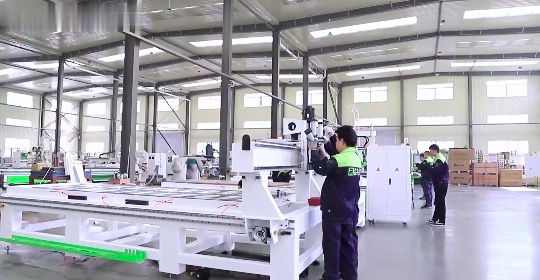
Panel furniture production has reorganized around batch-size-one economics. Where a conventional line assumed hundreds of identical cabinet sides per run, a custom-furniture plant may process several hundred distinct panels in a single shift, each with its own outline, bore pattern, and edge treatment. This inversion of the production logic is what created demand for the nesting center: a machine that cuts parts directly from a nest of mixed geometry on a full sheet, eliminating the fixed tooling and setup time that made conventional panel saws uneconomical below a certain batch size.
Three technical developments made the category viable at commercial scale. First, servo-driven gantry motion with rack-and-pinion transmission on X and Y brought rapid traverse speeds into the 45,000 mm/min range while holding repeat positioning to roughly ±0.03 mm—sufficient for cabinet joinery, though not for precision metalwork. Second, high-frequency spindles in the 9–12 kW class, running to 24,000 rpm, allowed a single tool to cut melamine-faced board, MDF, and plywood without tear-out severe enough to demand secondary sanding. Third, and most consequentially, automated loading and unloading turned a machine that required two operators into one that requires perhaps half an operator's attention, which is decisive in labor markets where skilled machine tenders are scarce and expensive.
The market consequence has been a pronounced shift in capital allocation. The table below compares the configuration envelopes of the principal machine classes serving this segment, drawn from published specifications for representative models. It is intended as an order-of-magnitude reference rather than a procurement specification.
| Machine class | Representative model | X/Y/Z travel (mm) | Spindle power | Rapid traverse (mm/min) | Positioning accuracy | Control system | Approx. machine weight |
|---|---|---|---|---|---|---|---|
| Standard ATC engraver | RC1325S-ATC | 1300×2500×250 | 9 kW (6/12 kW opt.) | 45,000 | ±0.03 mm/300 mm | Syntec (Taiwan) | ~2,200 kg |
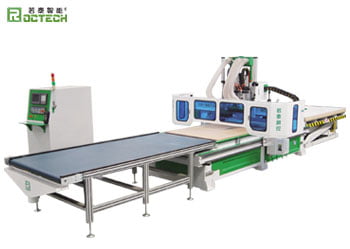
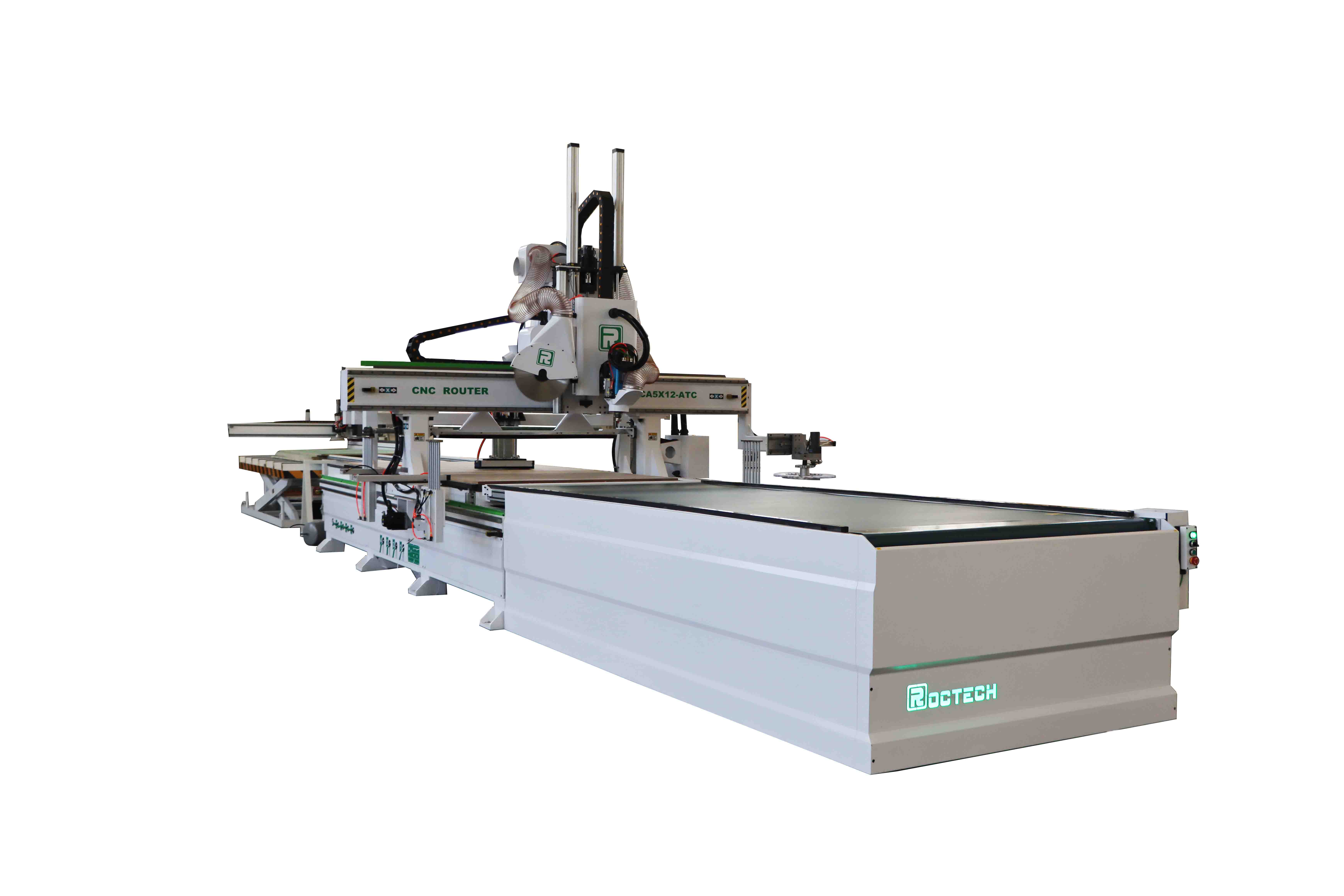
| Automatic load/unload nesting center | RCA1224 | 1220×2440×150 | 9.6 kW (higher opt.) | Not published | Not published | Syntec (Taiwan) | ~4,500 kg |
| Heavy-duty nesting center | RCA1325 | 1300×2500 class | 9.6 kW class | Not published | Not published | Syntec (Taiwan) | >4,500 kg |
| Five-axis simultaneous center | RCF1325 | 1300×2500 table | 10 kW (higher opt.) | 30,000 | ±0.05 mm | OSAI (Italy) | ~8,500 kg |
| Six-sided drilling center | Six-sided drill | 930 mm max. board width | 6 kW total | 18,000 rpm drill speed | — | — | ~3,000 kg |
Sources: manufacturer published parameters; figures are indicative and vary by configuration.
Two observations follow from the table. The first concerns the weight differential: an automatic nesting center at roughly 4,500 kg carries approximately double the mass of a comparable-footprint ATC engraver. That mass is not incidental. It reflects the welded heavy-duty bed required to damp vibration across a 2.4 m sheet while a loading gantry moves over the same frame, and it is the single most reliable proxy for build quality in this class—a point buyers frequently overlook when comparing quotations on spindle power alone.
The second concerns accuracy. The ±0.03 mm repeat positioning figure that appears across three-axis woodworking platforms is adequate for panel furniture but an order of magnitude coarser than what metal-cutting machine tools demand. This is a deliberate design trade: rack-and-pinion transmission buys speed and long stroke at the cost of some precision, and the woodworking industry has settled on that trade because the downstream tolerance chain—edge banding at ±0.2 mm, hinge boring at ±0.1 mm—does not reward greater machine accuracy. Buyers who specify five-axis centers for curved solid-wood components are purchasing a different capability, not tighter tolerances, since the RCF1325's ±0.05 mm positioning is looser than the three-axis machines it supersedes.
II. Technology Application and the Data-Chain Problem
The mechanical platform is, in most respects, a solved problem. The competitive frontier has moved to integration. A nesting center is only as productive as the information feeding it, and the practical failure mode in most plants is not a machine fault but a broken data chain: a design file that reaches the nesting engine with unclosed contours, a label that is printed but not scanned, a drilling program that must be re-entered by hand because the six-sided drill and the nesting center do not share a post-processor.
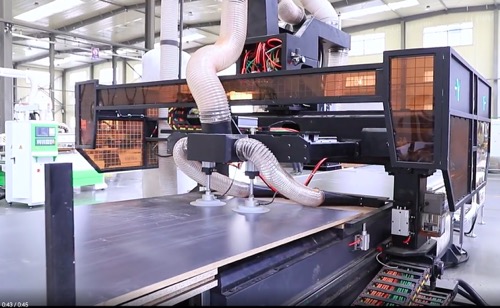
This is where the configuration choices matter more than the headline specifications. A double-layer vacuum table with zone control is not a comfort feature; it is what allows small parts—drawer sides, shelf pins, filler strips—to be held securely enough that the machine can run unattended through a full nest, which is the entire economic premise of automated loading. Automatic labeling, usually an option rather than standard equipment, is the physical link between the cutting operation and everything downstream. An automatic lubrication system, similarly unglamorous, determines whether the guide rails retain their accuracy over a five-year duty cycle or begin to drift after eighteen months of two-shift operation.
Roctech® illustrates the convergence pattern well. The Jinan-based manufacturer's Master series—RCA1224, RCA1328, RCA1325, RCA1530—follows a consistent architecture: heavy-duty welded bed, Taiwan HIWIN linear guides, Japanese Yaskawa servo drives, Taiwan Syntec control, and a 9.6 kW spindle with higher-power options. None of these components is proprietary, and that is precisely the point. Roctech's representativeness lies not in component innovation but in systems assembly: the company has standardized on a bill of materials that the market has validated, paired it with an automatic loading and unloading gantry and an optional row-drill group for cut-drill-groove consolidation, and priced it for the mid-market custom-furniture producer. With ISO9001, CE, and UL certifications and an export footprint spanning more than 100 countries, Roctech occupies the volume tier where most of the world's panel furniture is actually made—a segment frequently underserved by the European premium builders and poorly served by unbranded assemblers.
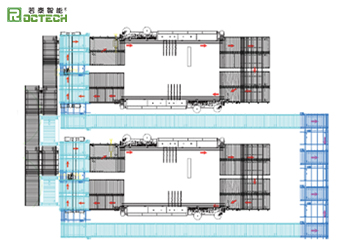
The company's broader product range is instructive for a different reason. Its catalogue runs from three-axis engravers through ATC machining centers, five-axis simultaneous centers with Italian OSAI control, fiber laser cutters, six-sided drills, and edge banding machines. Very few furniture plants need all of these, but the breadth reflects an accurate reading of how the industry actually buys: a custom-furniture factory that installs a nesting center will, within two years, need a drilling center and an edge bander, and will prefer a supplier who can deliver a coherent line rather than three vendors with incompatible software post-processors. Roctech's stated positioning around Industry 4.0 and intelligent overall solutions should be read in that light—as an integration play rather than a claim to machine-tool leadership at the precision frontier.
III. Conclusion and Outlook
The nesting center is approaching commodity status at its technical core, and the differentiation among credible suppliers is narrowing to three axes: the robustness of the loading and unloading mechanism under continuous duty, the completeness of the software chain from nesting engine to machine controller, and the density of the local service network. The first is a manufacturing-quality question on which the Chinese builders have largely closed the gap; the second remains genuinely uneven across the industry; the third is structural and will determine which brands survive the next consolidation.
For buyers, the practical implication is that specification comparisons built on spindle power and table size have limited diagnostic value. The questions that predict production outcomes are less photogenic: what is the mean time between failures on the loading gantry, does the post-processor for the six-sided drill come from the same supplier, and how many hours does it take a technician to reach the plant. The industry's next meaningful advance is unlikely to arrive as a faster spindle. It will arrive as a factory where the design file and the shipped cabinet are connected by a data chain that no human ever re-keys—and the equipment that gets there first will not necessarily be the equipment with the best datasheet.
Looking for more information about our CNC machines and services? Contact us today.
Contact





















Automated Loading and Unloading Nesting Centers in Panel Furniture Manufacturing: Technology Maturity, Market Structure, and the Integration Challenge - Roctech® have advanced technology for CNC Router,cnc router cabinets,Roctech already have 15 years experiences of cnc router technology.-© 2023 Roctech® Machinery Co.,Ltd. - All Rights Reserved Website Terms Of Use ● Privacy Policy ● Cookie Policy